Siena trip planner

A vacation guide to the gorgeous, Gothic Tuscan hilltown of Siena

Siena tourist ifo:
www.terresiena.it

Tours to Siena from Florence
• Siena and San Gimignano Day Trip from Florence
• Siena and San Gimignano Small Group Day Trip from Florence
• Context: Siena Half-Day Walk
• Private Tour: Siena and San Gimignano

Where to stay

Hotel Cannon d'Oro
Hotel Antica Torre
Hotel Duomo
Hotel Chiusarelli
Full story

» More hotels in Siena (from €64)
» B&Bs in Siena (from €45)
» Apartments in Siena (from €50)
» Agriturismi near Siena (from €75)

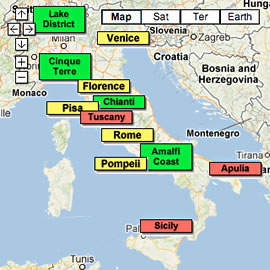
ReidsItaly.com Italy Map
View Larger Map


TOURS FROM OUR TRUSTED PARTNERS that include Siena

Intrepid: Tuscan ExpressPartner (7 days)
• G Adventures: The Taste of TuscanyPartner (8 days)
• iExplore: Magical Tuscany & Portofino Peninsula (10 days)
• iExplore: Cycle Through Siena & Chianti (8 days)
• iExplore: Tuscan Trails (self guided) (8 days)
• iExplore: Chianti: Walking & Wine (8 days)
• iExplore: Colors of Tuscany (8 days)

• G Adventures: Ultimate ItalyPartner (13 days)
• G Adventures: Italy Culture and History Explored (9 days)
• iExplore: Italy Experience (9 days)
• iExplore: Splendors of Italy & Southern France (16 days)

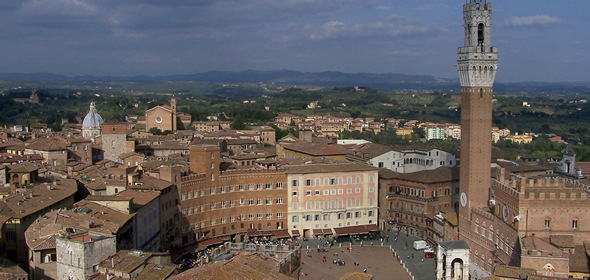
Il Campo
Piazza del Campo in Siena. (Photo by Zyance)
Siena Guide
Sleep
Eat
See
Shop
Planning FAQ
Siena is a city in hilltown clothing.

Its Gothic brick palazzi and marble Baroque church facades are splayed along three ridge tops centered along a trio of (usually) car-free boulevards: shopping drag Via Banchi di Sopra, touristy Via di Città, and quiet Via Banchi di Sotto.

The three meet just outside Siena's lovely main square, Piazza del Campo —often called just Il Campo—a sloping scallop shell of herringbone brick where people picnic, nap, and celebrate soccer victories.

The Campo and Palazzo Pubblico

Anchoring the base of the Campo is the crenellated 13th century town hall, the Palazzo Pubblico/Museo Civico (tel. +39-0577-292-223; www.comune.siena.it) is well worth the admission to admire its public spaces frescoed with Sienese Gothic masterpieces.

These include Simone Martini's courtly early Maestà (Madonna in Majesty) and a portrait of the knight Guidoriccio riding along in a richly patterned cloak (a mark of Sienese Gothic art).

The neighboring room—the meeting chamber for the old ruling Council of Nine—is decorated with the amazing Allegory of Good and Bad Government and its Effects on the Town And Countryside by Ambrogio Lorenzetti.

This cycle of frescoes is packed with scenes of 14th century daily life and is counted as perhaps the most important secular painting from medieval Europe. Its goal is to remind the Council of Nine of the effects their government will have.

Either they will enjoy a prosperous Siena, where men busily raise new buildings (proof that scaffolding rises eternal in Italy), shop keeps sell their wares, teachers instruct their students, noble ladies dance in the streets, and peasants happily toil away in the surrounding fields passed by gentlemen returning on horseback from falcon hunting.

Bad government will result in a blasted and destroyed city, passersby being crushed by crumbling buildings, the once-lush countryside ravished by famine and fire. (Perhaps fittingly, the frescoes forming this "bad government" side of the story are faded, cracked, and withered by age and mold.)

The Siena cathedral & its museum

The bulky, zebra-striped Gothic Duomo (or Cattedrale) is free except August 23 to October 2, when the stunning patchwork of inlaid and etched marble panels carpeting the floor are uncovered. Otherwise, a few panels are always left visible, and most of the Cathedral is free (save the Libreria Piccolomini, lushly frescoed by Pinturicchio and his young assistant Raphael). At the Duomo's crossing are a chapel by baroque master Bernini and a densely-carved pulpit by Gothic geniuses Nicola and Giovanni Pisano.

The Museo dell'Opera Metropolitana (tel. +39- 0577-283-048; www.operaduomo.siena.it) is installed in the thick wall of what was to have been the nave of a massively expanded cathedral (the existing cathedral would have become merely the transept of the gargantuan new church), an ambitious project halted when the Black Death claimed three-quarters of the population. In addition to a Madonna and Child tondo by Donatello and Duccio's glittering Gothic Maestà altarpiece of 1311—the first masterpiece of the Sienese School—the museum gives access to a narrow terrace (atop what would have been the entrance wall of the new cathedral) with a sweeping panorama of the city and countryside.

St. Catherine's house & remains

The Casa di Santa Caterina (tel. +39-0577-280-801) is a quiet, cloistered church and memorial of baroque paintings built around the birthplace of medieval mystic and stateswoman St. Catharine of Siena, Italy’s patron saint and first female Doctor of the Church. Her letters and 1378 ambassadorship to Gregory XII in Avignon were crucial in convincing him to return the papacy from France to Rome.

Just above, the gargantuan brick church of San Domenico preserves her shriveled head and thumb as relics in a chapel swathed in Renaissance frescoes by Sodoma and Francesco Vanni.

The Italian wine "museum" (read: "tasting gallery")

The brick vaults under the massive 16th century Medici fortress, once a symbol of Florence's dominance, now host the Enoteca Italian Permanente, a sort of national wine museum with tiny tables both under the echoing vaults and outside where you can sample the best of Italy's wine by the glass—and buy a bottle or two of your favorites, of course.

The Siena passeggiata

Stroll with the locals during Siena's popular evening passeggiata, which starts around 4:30pm. It concentrates on Via di Città and the southern arm of Via Banchi di Sopra, but I recommend heading up to the northernmost tip of Via Banchi di Sopra (it changes names a few times) to the Porta Camollia gate to the city.

From there, you can walk the entire main ridge upon which Siena is built, back down the main drag, joining the passeggiata crowds for a Campari at the Caffé Nannini (Via Banchi di Sopra 22-24; www.grupponannini.it).

Continue down Via Banchi di Sotto, dogleg right at Via S. Girolamo, then left up Via dei Servi to the rough brick façade of Santa Maria dei Servi church.

From the grassy square out front, the views spill across a verdant valley to a sunset over the cathedral on the opposite ridge.

Planning a trip to Siena

Related pages


   ShareThis


Search ReidsItaly.com

This material was last updated February 2011. All information was accurate at the time.

about | contact | faq

» THE REIDSITALY.COM DIFFERENCE «

Copyright © 2008–2012 by Reid Bramblett. Author: Reid Bramblett


Google