- Places
- Plans
- Itineraries
- Experiences
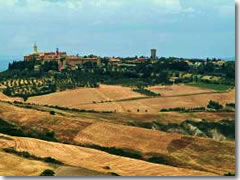
Pienza is miniscule: just a nine blocks long and three blocks wide, still encircled by its medieval walls, and a population that—including the surrounding area—tops out at 2,231. However, what would otherwise be a scenic blip on the map has an outsized history and major draw in the form of its central piazza.
Thanks to the quirky ambition and deep pockets of a homegrown pope, the main square of Pienza—and the buildings surrounding it and stretching down the main street— were all completely overhauled by a Renaissance architect and laid out as an homage to all those paintings of "the perfect Renaissance city."
What history owes to fuzzy accounting
Have you ever heard of a major renovation project that didn't come in late and way over budget? The makeover of Pienza was no different—though Rossellino also engaged in another time-honored tradition, that of faking the account ledgers so the client (in this case, the pope) wouldn't realize how much of the papal treasury was being drained into this little ego-trip of his.
It was a huge risk to take with the pope's pocketbook, but Rossellino’s gamble paid off. Pius II took a tour of his new town, and reportedly told his brilliant (if deceptive) architect:
“You did well, Bernardo, in lying to us about the expense... Your deceit has built these glorious structures, which are praised by all except the few consumed with envy.”
Rossellino broke down crying, and Pius II got his papal-sized dollhouse of a town. The pope almost immediately set off to Ancona to kick off a Crusade (a popular, and usually profitable, papal pastime) in order to top up the papal coffers.
Unfortunately, Pius II died in Ancona in 1464, still trying to raise his army. He never returned to Pienza.
He did, however, leave behind a missive that said, in so much Latin, "Don't touch anything until I get back."
Pienza took the pope's final wishes seriously, and to this day has the best-preserved Renaissance center of any town in the world.Enea Silvio Piccolomini was born to a prominent family in the miniscule Tuscan town of Corsignano. He entered the church, eventually became a cardinal, and in 1458 was elected Pope. He took the papal name Pius II (Pio Secondo, in Italian).
He also hired architect Bernardo Rossellino to do a Renaissance Extreme Makeover of little Corsignano, razing the center of the village and turning it into the architectural ideal of a perfect Renaissance city. The new look begged for a new name, so the pope modestly renamed Corsignano after himself—"Pio's town," or Pienza.
Pienza now centers around  Piazza Pio II, a square whose design was literally lifted right out of a Renaissance painting (or at least a popular theme of the era known as "The Ideal City," practiced by the likes of Raphael and Piero della Francesca).
The piazza is surrounded by a cathedral and three palaces, one each for the local government, for the bishop, and for Pius II himself.
The Duomo (Cathedral)—with the Piccolomini coat of arms over the rose window—is actually Gothic inside, ranged with altarpieces by 15th century Sienese masters and spangled, inside and out, with more than 400 cinque lune (five moons) devices, the Piccolomini family symbol.
Note the huge crack that runs along the floor and up the left-hand wall neat the apse end of the church. The church was built right up to the the edge of Pienza's little cliff, which allows light to stream through its windows, but slow erosion and general subsidence of the cliff face has for centuries threatened to collapse the entire altar-end of the structure.
Across from the Duomo is the porticoed Palazzo Comunale, a Renaissance take on the typical medieval town hall.
Flanking the piazza are the papal palace (Palazzo Piccolomini) and the bishop's palace (Palazzo Vescovile).
Rossellino built the pope's personal Palazzo Piccolomini along lines similar to those used by his teacher, Alberti, on the Palazzo Rucellai in Florence—but with one significant addition. Rossellino tacked on an Italian version of that ancient Mesopotamian standby, the hanging garden (on the left of the inner courtyard).
This comprises a triple-decker loggia spilling over with plants above a tiny strip of box hedges, all of it rising directly atop Pienza's little cliff for sweeping countryside views that stretch across the patchwork of fields to Monte Amiata in the distance.
You can only visit the palazzo, the gardens, and the papal apartments (kept intact by the Piccolomini family, who continued to live here until the 1960s) by taking one of the half-hourly tours. Piazza Pio II, tel. +39-0578-749-392, www.palazzopiccolominipienza.it; Closed Mon.
Across the piazza, the Palazzo Vescovile (Bishop's Palace) was built by Pius II’s nephew and flunky, Cardinal Roderigo Borgia (who later became Pope Alexander VI—yes, that Pope Alexander, the infamous Borgia Pope, whose reign was rife with sex scandals, assassinations, and fratricide).
The Palazzo Vescovile now houses the town's Museo Diocesano, with some fine Sienese altarpieces by Il Vecchietta and Bartolo di Fredi. Corso Rossellino 30, tel. +39-0578-749-905. Closed Tues.; open weekends only Nov–mid-Mar.
Next door on Corso Rossellino is one of the few buildings to survive Pius II’s remodeling, the 14th-century San Francesco church, in whose dark interior are some fresco fragments.
The alley between San Francesco and the Palazzo Piccolomini leads to Via Gozzante, a walltop walk that shares the panoramic valley views of the hanging garden.
Pecorino glossary
Ages:
fresco - fresh (firm; for table eating)
rosso - red (aged 3 months with a thin, red rind; for table eating)
semistagionato - partly aged (semi-hard; for table eating)
stagionato - aged (hard; suitable for grating)
Coatings/varieties:
cenerato or sotto cenere - ash (softer)
peperocinato - hot peppers (spicy)
tartufato - truffles (earthy)
marzolino - "March" cheese (soft and creamy; available only in early spring)
pecorino di fossa - aged in a cave (earthy)
erbe - wild herbsThe surrounding rolling grasslands raise the sheep that provide Pienza with its other claim to fame—arguably Italy's best and finest pecorino cheeses, available in multiple styles and flavors at the handful of shops and boutiques in this tiny town.
Pecorino just means "sheep's cheese." It is often referred to by its nickname, cacio (pronounced KA-cho). This is no, however, the hard, salty/sweet pecorino romano you are used to grating onto your pasta back home. Though there are various stages of aged, hardened pecorinos on hand, the best pecorinos in Pienza are of the pecorino fresco, or fresh, variety, a soft, buttery cheese that brims with subtle flavors.
Many cheeses are also cured or aged in various wrappings or coatings, imparting still more flavors (some producers actually mix flavors into the cheese itself—bits of black truffle are popular—but purists scoff that this mars the taste and the cheese).
Luckily, nearly every shop in town will let you sample for free so you can decide for yourself. See the "Pecorino glossary" box on the right for a list of the more popular varieties. Among the best cheese shops are:
As a bonus, most cheese shops double as wine enoteche, and—since, unlike its wine-crazy neighbors in Montalcino, Montepulciano, or the Chianti region, Pienza has no world-class wines of its own to trumpet—the advice in these shops tends to be a bit less partisan and more honest when it comes to the various merits of the mighty red wines of Tuscany.
Tourist info office:
Ufficio Informazioni Turistiche di Pienza
Corso il Rossellino 30/Piazza Pio II, Pienza
tel. +39-0578-749-905
www.comune.pienza.siena.it
Useful private websites:
www.pienza.info
www.ufficioturisticodipienza.it
www.portalepienza.it
★ Hotel Relais Il Chiostro Di Pienza [€€]
Hotel Arca di Pienza [€€]
Hotel Il Giardino Segreto [€€]
Hotel Antica Locanda [€€]
» More hotels in Pienza (from €76)
» B&Bs in Pienza (from €59)
» Apartments in Pienza (from €70)
» Agriturimsi near Pienza (from €79)
Share this page
Search ReidsItaly.com
Tourist info office:
Ufficio Informazioni Turistiche di Pienza
Corso il Rossellino 30/Piazza Pio II, Pienza
tel. +39-0578-749-905
www.comune.pienza.siena.it
Useful private websites:
www.pienza.info
www.ufficioturisticodipienza.it
www.portalepienza.it
★ Hotel Relais Il Chiostro Di Pienza [€€]
Hotel Arca di Pienza [€€]
Hotel Il Giardino Segreto [€€]
Hotel Antica Locanda [€€]
» More hotels in Pienza (from €76)
» B&Bs in Pienza (from €59)
» Apartments in Pienza (from €70)
» Agriturimsi near Pienza (from €79)



This article was written by Reid Bramblett and was last updated in April 2015.
All information was accurate at the time.
about | contact | faq
» THE REIDSITALY.COM DIFFERENCE «
åß
Copyright © 2008–2017 by Reid Bramblett. Author: Reid Bramblett


