In choosing a date to mark the beginning of the Renaissance, art historians often seize on 1401, the year Florence's powerful wool merchant's guild held a contest to decide who would receive the commission to design the Baptistery's North Doors to match the Gothic South Doors cast 65 years earlier by Andrea Pisano.
The era's foremost Tuscan sculptors each designed and cast a bas-relief bronze panel depicting his own vision of The Sacrifice of Isaac. Twenty-two-year-old Lorenzo Ghiberti—competing against the likes of Donatello, Jacopo della Quercia, and Filippo Brunelleschi—won hands down.
Since the reasons the judges chose Ghiberti's contest submission were based on the aspects of art (realism, dynamic composition, perspective techniques) that would become the keystones of the Renaissance, many scholars chose this date, 1401, to mark the beginning of the Renaissance.
(Why few guidebooks mention this is beyond me, but: Two of the submitted bronze panels from that 1401 competition—Ghiberti's and Brunelleschi's—are preserved in the Bargello sculpture museum. Also, Brunelleschi, huffy about losing, decided to abandon sculpture and turn his focus to architecture instead; wise move, since he later returned to build the famous dome over the cathedral, revolutionizing Renaissance architecture)
Ghiberti spent the next 21 years casting 28 bronze panels and building his doors.
Although limited by his contract to design the scenes within Gothic frames as on Pisano's doors, Ghiberti infused his figures and compositions with an unmatched realism and classical references that helped define Renaissance sculpture. (Ghiberti stuck a self-portrait in the left door, the fourth head from the bottom of the middle strip, wearing a turban.)
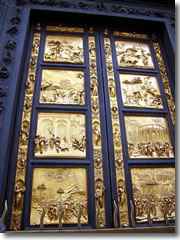
The result so impressed the merchant's guild—not to mention the public and Ghiberti's fellow artists—they asked him in 1425 to do the East Doors, facing the Duomo, this time giving him the artistic freedom to realize his Renaissance ambitions.
Twenty-seven years later, just before his death, Ghiberti finished ten dramatic life-like Old Testament scenes in gilded bronze, each a masterpiece of Renaissance sculpture and some of the finest low-relief perspective in Italian art. (The panels now mounted here are excellent copies; the originals are displayed in the nearby Museo dell'Opera del Duomo).
Years later, Michelangelo was standing before these doors and someone asked his opinion. His response sums up Ghiberti's life accomplishment as no art historian ever could: "They are so beautiful that they would grace the entrance to Paradise."
They've been called the Gates of Paradise ever since.
The Florence Baptistery—directly across from the Cathedral—is one of Florence's oldest, most venerated buildings. It is, in fact, the oldest building of the whole Duomo ensemble. Florentines long believed it was originally a Roman temple, but it most likely was raised somewhere between the 4th and 7th centuries on the site of a Roman palace.
The octagonal drum was rebuilt in the 11th century, and by the 13th century it had been clad in its characteristic green-and-white Romanesque stripes of marble and capped with its odd pyramidlike dome.
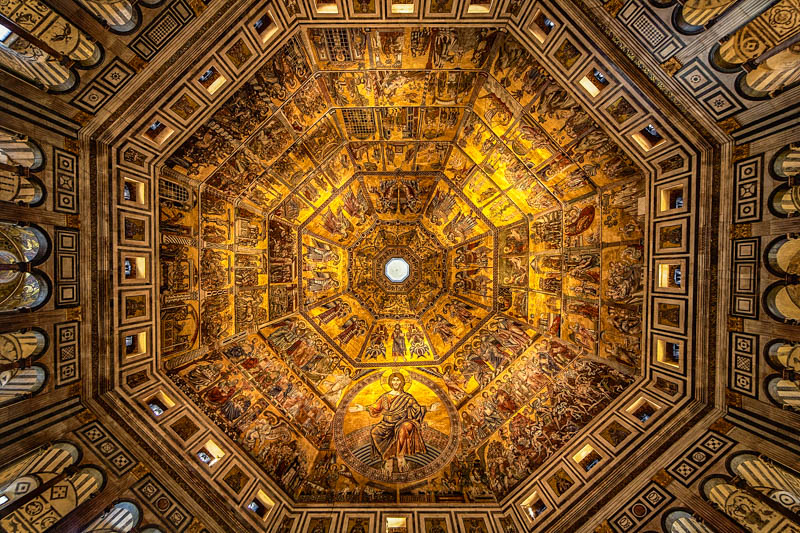
The Baptistery's interior, open the afternoons only, is ringed with columns pilfered from ancient Roman buildings and is a spectacle of mosaics above and below.
The floor was inlaid in 1209, and the ceiling was covered between 1225 and the early 1300s with glittering mosaics. Most were crafted by Venetian or Byzantine-style workshops, which worked off designs drawn by the era's best artists.
Coppo di Marcovaldo drew sketches for the over 26.4-foot (8m) ape-toed Christ in Judgment as part of the incredibly detailed Last Judgment which fills over a third of the cone-shaped ceiling.
To the right of the altar is the 1425 is the Tomb of Antipope John XXIII, designed by Renaissance architectural giant Michelozzo and decorated by none other than Donatello.
This begs two questions: (1) What is an antipope? and (2) What is one doing with a tomb decorated by such important artists in such a sacred spot?
So, what is an antipope? Starting in the third century, the complicated politics of the church often created two or three "antipopes" each century, usually rival claimants to the bishopric of Rome (remember, that's the pope's only real office: he's the Bishop of Rome), or two top cardinals backed by competing emperors, kings, or other powers.
Things came to a head in the late 14th century when, to break the string of fairly corrupt French popes out of Avignon, the conclave of cardinals elected a Pugliese man to become Pope Urban VI. Several of them soon had second thoughts, convened again in 1378, declared Urban VI's election to be invalid, and set up Robert of Geneva as Pope Clement VII, based in Avignon.
This began the Great Western Schism, and I'm just glossing over it here, but things were a mess. There was a succession of rival popes, one based in Rome and one in Avignon, who spent much of their time excommunicating one another and trying to win a critical mass of support from other European powers.
In 1409, a group of cardinals got disgusted enough with both camps—after both popes promised to attend at meeting to resolve the issue then balked and never showed—that a church council convened in Pisa. It voted to depose both Rome and Avignon's popes and—yep—elect a third man to become Pope Alexander V.
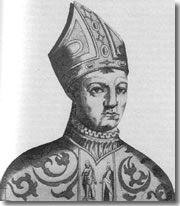
Baldassare Cossa, better known as Antipope John XXIII.So now the church had three popes, each claiming to be the only legitimate one. Alexander V died less than a year into his pseudo-papacy, and he was succeeded by John XXIII.
John XXIII's real name was Baldassare Cossa, and he was a decent enough bloke, the head of the Council of Pisa that had elected Alexander V. (Though, if you believe famed historian Edward Gibbon, John XXIII was guilty of incest, rape, sodomy, murder, and, my favorite, piracy. There is strong evidence this was all just slander, part the cross-continental mudslinging that came with the Great Schism.)
Whatever else he may have done, John XXIII was instrumental in ending the Great Western Schism. At the behest of Emperor Sigismund, he convened the Council of Constance in 1412. Eventually—after a rousing couple of years that included flights, imprisonment, escape, reconciliation, and more—both John XXIII and the Roman Pope Gregory XII agreed to authorize the council to elect a single new pope. Then, incredibly, both men abdicated their papacies (though how willingly is the subject of much discussion). The council quickly excommunicated the holdout pope in Avignon, Benedict XIII, and in 1417 elected a Roman cardinal named Odo Colonna to become Pope Martin V.
The Great Western Schism was over.
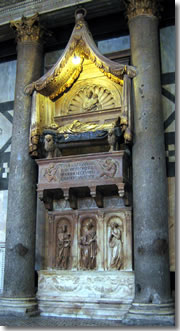
The tomb of Antipope John XXIII, by Donatello and Michelozzo, in Florence's Baptistery. (Photo by Richardfabi)Baldassare Cossa, the man who gave up the papacy (or at least a papacy) and helped restore the church, died in Florence on December 22, 1419, just six months after Martin V made him a cardinal again in the restored church.
So, why the grand tomb? Cossa had made a key ally of Florence in 1504, when he helped the city conquer Pisa. He also made a key alley of Florence's Medici clan when, as pope, he designated that the family become the official bankers for the papacy—a legacy upon which the Medici would found centuries of fame, fortune, and power.
The Medici were too shrewd as politicians to forget their friends.
This is why Cossa's executors—most prominently Medici dynasty founder Giovanni di Bicci de' Medici and his son Cosimo—chose to honor the pope they had backed with a magnificent tomb, one that reportedly cost more than 1,000 florins, was crafted by the city's foremost artists, and was installed in the very ecclesiastical heart of the city: inside the ancient baptistery.
It was the last time any pope was buried outside of Rome.
Piazza del Duomo/Piazza San Giovanni
tel. +39-055-230-2885
www.operaduomo.firenze.it
Mon–Fri 8:15–10:15am and 11:15am–7pm
Sat 8:15am–7pm
Sun 8:15am–2pm
€15 (covers entire Duomo Group)
With Firenze Card: Free
Bus: C2; 14, 23, C1
Hop-on/hop-off: Stazione FS SMN (A, B), Piazza Stazione (C)
Planning your day: It should take about 20–30 minutes inside the Duomo itself, another 20–30 minutes in and around the Baptistery. Climbing either Brunelleschi's dome (463 steps) or Giotto's bell tower (414 steps) will take about an hour each. The Duomo museum will eat up 45–90 minutes of your time, depending on how into it you get.
The ticket allows you to enter each sight two times, if you wish, but sadly is only good for the day you buy it, so you have to do them all at once.
The last entry for the battistero is 30 minutes before closing.
If you happen to visit on a Sunday, arrive just after early lunch to hit the baptistery first—as it's open only 8:30am to 2pm—then do the cathedral once it reopens after morning mass.
While the cathedral itself is free, everything else in the Duomo group are on a single, €15 cumulative ticket that covers all of the Opera del Duomo group sights: the Duomo itself, Cupola (cathedral dome) Baptistry, Campanile (Belltower), S. Reparata (excavations under the Duomo), and the newly repoened the Museo.
Sadly, the ticket is is only good for the day you buy it, so you have to do them all at once.
Note: All the sights in the Duomo group are also covered by the Firenze Card. » more
Take a guided tour of Battistero di San Giovanni with one of our partners:
Weekdays, mass is held here at 10:30am and 11:30am. For more: www.coordinamentochiesedifirenze.it
Share this page
Search ReidsItaly.com
Piazza del Duomo/Piazza San Giovanni
tel. +39-055-230-2885
www.operaduomo.firenze.it
Mon–Fri 8:15–10:15am and 11:15am–6:30pm
Sat 8:15am–6:30pm
Sun 8:15am–1:30pm
€15 (covers entire Duomo Group)
With Firenze Card: Free
Bus: C2; 14, 23, C1
Hop-on/hop-off: Stazione FS SMN (A, B), Piazza Stazione (C)



This article was written by Reid Bramblett and was last updated in September 2014.
All information was accurate at the time.
about | contact | faq
» THE REIDSITALY.COM DIFFERENCE «
åß
Copyright © 2008–2017 by Reid Bramblett. Author: Reid Bramblett