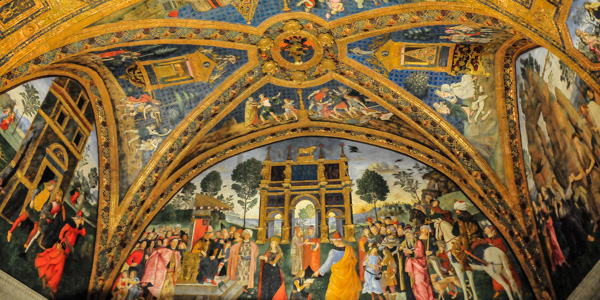
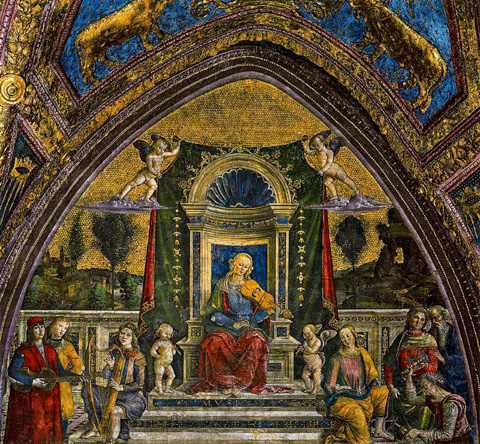
The Borgia Apartments, downstairs from the Raphael Rooms, were painted by Pinturicchio and occupied by the infamous Spanish Borgia pope Alexander VI (you know: that devilish guy played by Jeremy Irons in the Borgias TV series).
This apartment suite was closed off by Julius II—who refused to live in rooms sullied by his venal predecessor—and its frescoes covered with black crepe.
Things remained that way for 386 years, until the apartments were reopened in 1889 to serve as display rooms for the Vatican's collection of (frankly bland, for the most part) modern religious art.
More importantly, when they reopened in 1889, the Vatican also finally uncovered the walls and ceilings to unveil the rich frescoes, painted by Pinturicchio with wacky early-Renaissance Umbrian fantasy.
A co-pupil of Raphael’s under master Perugino, Pinturicchio had a penchant for embedding fake jewels and things like metal saddle studs in his frescoes rather than painting these details in for an intriguing effect—call it Renassiance 3D.
While Pinturrichio's art is not necessarily at its top form in these rooms, they're worth a run-through.
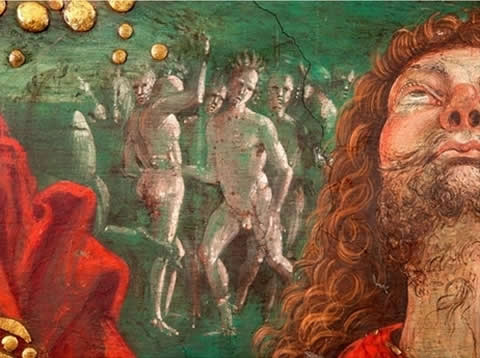
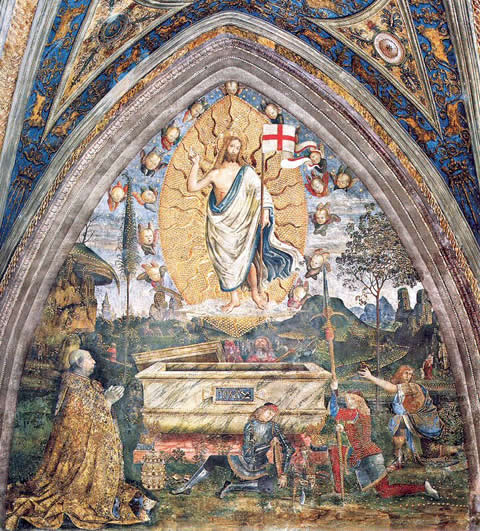
The frescoes have been (finally) getting restored over the past several years, and the cleaning revealed something amazing: the first European depiction of Native Americans.
In the scene of The Risen Christ (a.k.a. The Ressurection)—just above the casket and to the left of the head of the long-haired man in red robes gazing up at Jesus—is a tiny scene of naked men in feathered headresses dancing around a pole. One even appears to be styling a mohawk hairdo.
What makes this even more remarkable is that these frescoes were finished by 1494—just two years after Columbus made landfall in the Caribbean and a mere 18 months or so after he returned from that voyage and handed over his journals to Ferdinand and Isabella of Spain.
More intriguing: While this scene was being painted, the crowned heads of Europe were still desperately trying to keep discovery of the New World a secret while they divvied up the rights to any future discoveries.
So while Columbus' discovery was something of a state secret at the time, Alexander VI apparently just couldn't resist a little bragging via fresco. He must have shared Columbus' description of the natives with Pinturicchio so he could slip them in there.
And that balding, pius-looking fellow kneeling in rich gold robes on the left side of the scene? It's Rodrigo Borgia himself: Pope Alexander VI.
Alexander VI spent the 1480s and early 90s issuing papal bulls attempting to control how the new discoveries being made by Spain and Portugal be divided up.
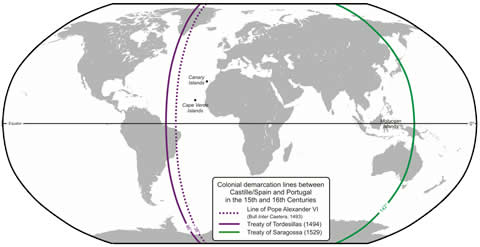
Eventually, all the powers involved sat at the table to negotiate the "Treaty of Tordesillas."
The goal of this treaty was to demarcate a north-south meridian that sliced the globe halfway between the Cape Verde islands (then held by Portugal) and the new "West Indies" that Columbus had discovered for Spain (modern-day Cuba and Hispanola—a.k.a. Haiti & the Dominican Republic).
The new rule: Spain could lay claim to any new lands discovered west of that line; Portugal to anything east of it.
Keep in mind that, at the time, only those few Caribbean islands had been discovered—and, if the monarchs truly bought Columbus' (wrong) theory, everyone still thought these were merely offshore islands of Asia. No one had any idea that there were two giant continents just beyond.
However, a case has been made the Portuguese already knew at least a bit about the eastern coast of South America—but had kept it a secret. This would explain why they kept insisting on nudging the Tordesillas line farther and farther to the west into what was widely thought to be simply empty Atlantic.
This conspiracy theory holds that their goal was to make sure the line would pass right through the eastern bulge of South America, presumably already discovered by earlier intrepid Portuguese explorers. Why? So that in 1500, en route to India, Captain Pedro Álvarez Cabral could just sort of casually swing by—through supposedly unknown seas, mind you, and way, way out of the way from his original sailing plans—"stumble" across South America, and immediately claim this land for Portugal.
Whatever the case, this Tordesillas line is why, to this day, they speak Portguese in Brazil but Spanish just about everywhere else in the Americas.
Once you are done with the Borgia Apartments, you can climb back up and head straight to the Sistine Chapel, or continue downstairs to visit more (slightly better) Modern Art first.
Viale Vaticano (on the north side of the Vatican City walls, between where Via Santamaura and the Via Tunisi staircase hit Viale Vaticano; about a 5–10 minute walk around the walls from St. Peter's).
tel. +39-06-6988-4676 or +39-06-6988-3145
www.museivaticani.va or www.vatican.va
Mon–Sat 9am–6pm (last entry: 4pm)
* May 2–July 25 and Sept 5–Oct 31 also open Fridays 7–11pm with advance booking (» more)
* Open the last Sun of each month 9:30am–2pm—and it's free!... and terribly crowded
* For other closed dates, see "tips" below
€16
Roma Pass: No
Tickets: Select Italy or Viator
Bus: 49; 490, 492, 496; 23, 32, 81,Tram 19, 271, 492, 590, 982, 990
Metro: Cipro-Musei Vaticani (A)
See "Tips" for more info
Planning your day: The Borgia Apartments take about 15–20 minutes—but expect to spend all day at the Vatican. Two days if you can swing it. Even on a tight schedule, expect to pretty much spend one full day seeing the Vatican Museums and St. Peter's together. They're worth it.
Warning: The ticket office closes 2 hours before the museum, with the last entry at 4pm.
You can book Vatican entry tickets ahead of time to help avoid the lines, which can last for up to an hour or so in the summer. However, this adds a €4 fee to the already steep admission of €16 at www.vatican.va. Or you can do it online via one of our partners:
Vatican tours: There are two-hour tours of the museums and Sistine Chapel available (in English usually four time a day) for €32 per person. Three-hour tours that also include St. Peter's cost €37. Note, though, that those prices include the €16 admisison ticket and €4 booking fee, so the tour portion actually only costs an extra €12–€15. For more info: tel. +39-06-6988-3145 or www.vatican.va.
If you prefer a private guided tour of the Vatican and its museums, book one via our partner sites Viator.com or Context Travel:
The Vatican Museums are free on the last Sunday of each month, when they stay open until 2pm (last entry: 12:30pm). This, however, is no secret, so they are also intensely crowded.
On any other Sunday, however, the Vatican Museum are closed—and if that final Sunday of the month happens falls on a church holiday (see below), they also remain closed.
The Vatican is also free on Sept. 27 (World Tourism Day)..
The Vatican Museums are most crowded on Sundays (because they're free) and many Wednesdays (because in the morning St. Peter's itself is often closed for the papal audience in the piazza, so everyone who doesn't have tickets walks around the walls to kill time inside the museums, and by afternoon all the audience-goers join them).
The Vatican has been experimenting with reopening the museums on Friday evenings in spring and early summer then again in fall allowing a limited number of visitors—upon advance booking only—to wander the mooonlit galleries without the crowds.
More info: www.vatican.va.
To book: Viator.com
The Vatican Museums are closed on all church holidays: Jan. 1, Jan. 6, Feb. 11, Mar. 19, Easter Sunday and Monday, May 1, June 29 (Feast of St. Peter and Paul—major Roman holiday), Aug. 14–15 (everything is closed in Rome on Aug. 15; head to Santa Maria Maggiore for mass with a "snowfall" of rose petals), Nov. 1, Dec. 25 (Merry Christmas!), and Dec. 26 (Santo Stefano—huge in Italy).
Note that the Vatican Museums close surprisingly early (last entry at 4pm, doors close 6pm).
So see the Museums first, then walk around the walls to visit St. Peter's.
Recently, the Vatican (or at least some guards) seems to have decided that you must dress "appropriately" to visit any part of Vatican City—including the museums—and not just St. Peter's, where a dress code has long applied.
Err on the side of caution and make sure you arrive with no bare shoulders, knees or midriffs.
That means: no shorts, no miniskirts, no sleeveless shirts or blouses, no tank-tops. Also, no hats.(If it's hot and you want to wear a tank top around town that day, just bring a light shawl to cover your shoulders while inside; » more on packing the right items for an Italy trip.)
Also, you cannot bring into the museum any bag or backpack larger than 40cm x 35cm x 15cm (roughly 16" x 14" x 6")—there is a cloackroom where you can leave it.
Cipro-Musei Vaticani is the closest Metro stop (on the A line, about 5 blocks northwest of the entrance; just follow the crowds).
Otherwise, bus 49 stops right in front of the museum entrance (you can catch it from Piazza Cavour, or anywhere along Via Cescenzio, which starts at the northwestern tip of the piazza, near Castel Sant'Angelo).
You can also take bus 490, 492, 496, N1 to Via Candia (two blocks north of the entrance), or one of many bus lines to Piazza del Risorgimento, tucked into a inside corner of the Vatican walls a short walk east of the musuems entrance: 23, 32, 81,Tram 19, 271, 492, 590, 982, 990, N11.
Share this page
Search ReidsItaly.com
Viale Vaticano (on the north side of the Vatican City walls, between where Via Santamaura and the Via Tunisi staircase hit Viale Vaticano; about a 5–10 minute walk around the walls from St. Peter's).
tel. +39-06-6988-4676 or +39-06-6988-3145
www.museivaticani.va or www.vatican.va
Mon–Sat 9am–6pm (last entry: 4pm)
* May 2–July 25 and Sept 5–Oct 31 also open Fridays 7–11pm with advance booking (» more)
* Open the last Sun of each month 9:30am–2pm—and it's free!... and terribly crowded
* For other closed dates, see "tips" below
€16
Roma Pass: No
Tickets: Select Italy or Viator
Bus: 49; 490, 492, 496; 23, 32, 81,Tram 19, 271, 492, 590, 982, 990
Metro: Cipro-Musei Vaticani (A)
See "Tips" for more info
Public transportation:



This article was written by Reid Bramblett and was last updated in March 2014.
All information was accurate at the time.
about | contact | faq
» THE REIDSITALY.COM DIFFERENCE «
åß
Copyright © 2008–2017 by Reid Bramblett. Author: Reid Bramblett