- Places
- Plans
- Itineraries
- Experiences
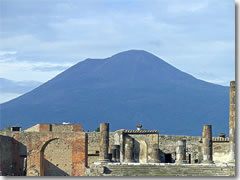
Mt. Vesuvius still menaces the ruins of Pompeii.Though one of the smallest and least regularly active volcanoes in the world, Vesuvius is one of the most famously destructive (more on that in a moment).
The only active volcano on continental Europe, the 4,214-foot-high, broad cone of Mt. Vesuvius dominates the Bay of Naples from the northeastern shore.
Vesuvius is the worst sort of volcano, built much the way a science fair model might imagine one: a pool of molten magma under the ground with and a long tube running straight up through the center of the mountain to a crater at the top. This volcano lies quiet, seemingly dormant for centuries—even millennia—the crater a wide but kind of boring depression filled with pale russet and gray pumice stone and dirt.
It seems so innocuous that only a few ancient scientists even realized it was a volcano—and even they figured it was extinct—and so safe that Spartacus and his rebel slaves took shelter in it during their revolt. Vesuvius' danger lies unseen beneath the surface.
That "tube" in the mountain's center is blocked by plug of rock and ash, and the boiling magma underneath is slowly building up and superheating a giant pocket of gasses, which put increasing pressure on that plug, like a giant bottle of champagne that been shaken violently.
The 19th century commercial jingle that just won't dieVesuvius sounded off with an explosive, pyroclastic flow in 1631, killing around 3,000 people along the shore, and in 1944 gave a spectacular, but relatively mild, show in an effusive eruption that spit some lava and gasses into the air.
Some 650,000 people currently live in the projected "death zone" around Vesuvius. Many pray to the Madonna del Vesuvio to guard against eruptions, and they may be wise to do so.
There have been several hundred micro-earthquakes under Vesuvius in the past several years, and vulcanologists figure there's another big eruption slowly building up force inside.
At best, it will take seven days to evacuate the area fully, but even predictable volcanoes rarely give that much warning.
Vesuvius is anything but predictable, and that is how it made history.
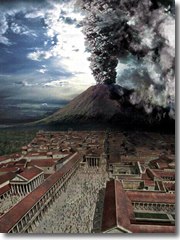
The mountain was acting up with tremors more than usual during the early months of AD 79, but no one in Pompeii or Herculaneum was expecting the cataclysmic eruption that came with little warning at noon on August 24.
The top of Vesuvius blew 12 miles into the air, and lava, ash, and pumice thundered down the sides of the volcano.
By midnight, it was over. Pompeii lay buried under at least ten feet of ash, and Herculaneum under 80 feet of mud.
Lest we forget its nature, this mountain has been named "Vesuvius," from Vesbius, which means "the unextinguished," a reminder handed down through the ages that the horrible volcano but slumbers underneath the placid mountain.
Vesuvius information:
www.parconazionalevesuvio.it
[Shortcut to the section about visiting the crater]
To visit the crater of Vesuvius, take the Circumvesuviana train from Naples or Sorrento to the Ercolano Scavi stop (» more), from which there's a special bus (tel. 081-739-2833) five times daily up to the Colle Margherita parking lot at 1,000 feet above sea level 55 min.).
From here—after paying admission to what has been since 1995, a National Park—you can walk the final 450 yards (and 560 vertical feet of elevation) to the crater itself.
The crater's rim, a barren landscape with unparalleled views across Campania on clear days. Paid guides are also avaiable. The last return bus leaves Vesuvius at 5:30pm.
From Pompeii, you can also catch a "Trasporti Vesuviani" bus here five times daily; buses leave Pompei down in the modern town's Piazza Anfiteatro.
Share this page
Search ReidsItaly.com
Vesuvius information:
www.parconazionalevesuvio.it
[Shortcut to the section about visiting the crater]



This article was written by Reid Bramblett and was last updated in April 2015.
All information was accurate at the time.
about | contact | faq
» THE REIDSITALY.COM DIFFERENCE «
åß
Copyright © 2008–2017 by Reid Bramblett. Author: Reid Bramblett



